
 Written by
 CREATIVE BLOG ACADEMY
Lecturer / Tutor
Creative Blog Africa
INTRODUCTION
If you have ever opened YouTube and thought, “I want to start, but I honestly don't know where to begin,” this masterclass is for you.
Maybe you have a smartphone. Maybe you have an idea. Maybe you have watched other people build channels and wondered how they got their first 100 subscribers, their first 1,000 views, or eventually their first income.
And perhaps you have also heard completely different advice:
Post every day.
Buy a camera.
You need 10,000 subscribers.
The algorithm hates small channels.
Just make Shorts.
Long videos are better.
Use AI to make everything.
Your first video must go viral.
Let me stop you there.
A lot of YouTube advice sounds complicated because people often explain the platform from the perspective of someone who has already been creating for years.
This lesson is different.
We are starting from zero.
You do not need an expensive camera. You do not need a studio. You do not need thousands of subscribers before you can take YouTube seriously.
What you need first is an understanding of how YouTube works, who you are creating for, what problem your content solves, how viewers respond to your videos, and how you can turn what you learn into a repeatable system.
And because this is the 2026 YouTube environment, we also need to understand current monetization rules, copyright, reused content, AI-generated material, community guidelines and the business side of being a creator.
So, sit down, take your time with this lesson, and treat it like a classroom.
By the end, you should not simply know what YouTube is.
You should know what to do next.
1. WHAT YOUTUBE REALLY IS IN 2026
A beginner may think YouTube is simply a website where people upload videos.
It is much bigger than that.
YouTube is simultaneously:
A video platform.
A search engine.
A recommendation system.
An entertainment platform.
An educational platform.
A community.
A discovery engine.
A distribution channel.
A media business.
And, for some creators, a full-time career.
That combination is what makes YouTube so powerful.
Someone in Lagos can publish a tutorial today and have it discovered by somebody in Nairobi, London, Accra, New York or Johannesburg.
You don't have to start with an audience.
You can start by creating something useful enough for the right person to discover.
That distinction matters.
YouTube is not only about subscribers
Subscribers matter, but they are not the whole story.
A channel with 500 subscribers can sometimes get more views on a particular video than a channel with 20,000 subscribers.
Why?
Because YouTube recommendations are personalized. The system considers what individual viewers watch, search for, engage with and appear to enjoy, among many other signals.
YouTube describes its recommendation system as being designed to connect viewers with content they are likely to watch and enjoy, with long-term viewer satisfaction as a central goal.
So don't build your entire mental model around:
How many subscribers do I have?
Ask:
Am I making videos that the right people actually want to watch?
That is a much more useful question

PURPOSE:
Shows that a creator can begin with simple equipment and reach a global audience.
2. BEFORE YOU CREATE YOUR FIRST VIDEO
Before you press record, I want you to answer five questions.
1. Why do you want to be on YouTube?
Maybe you want to:
Teach
Entertain
Document your journey
Build a personal brand
Promote a business
Build a community
Sell products
Generate leads
Create another income stream
Build a media career
There is no single correct answer.
But knowing your reason helps you make better decisions.
2. Who are you trying to help or entertain?
Don't say:
Everybody.
Everybody is not an audience strategy.
Imagine you tell me:
I want to create a business channel.
I would ask you:
Business for whom?
A Nigerian university student trying to make their first ₦100,000 online needs different content from an established business owner trying to scale a ₦50 million company.
The subject may be the same.
The audience is different.
3. What problem, desire or interest are you addressing?
People don't usually click because you created a video.
They click because the video appears relevant to something they care about.
That might be:
How do I edit a video?
Which phone should I buy?
How do I start a business?
Why is my website slow?
How can I cook this meal?
What happened in this story?
How can I pass this exam?
How do I get my first client?
4. What can you realistically sustain?
If you have school, work, family responsibilities or a limited budget, don't design a production system that requires you to behave like a full-time studio.
Start with what you can maintain.
5. What do you want your channel to become?
Your first 10 videos don't need to reveal your entire future.
But you should have a direction.
TRY THIS
Complete this sentence:
I create videos for
who want to
For example:
I create simple digital
skills videos for Nigerian beginners who want to start earning online.
That is already much clearer than:
I make videos about technology.
3. HOW TO CHOOSE A NICHE THAT CAN LAST
Let's simplify five words:
Topic → Niche → Audience → Problem → Transformation
A topic is broad.
Example:
Business.
A niche is more specific.
Online business for Nigerian beginners.
The audience is the specific group.
Nigerians aged 18–30 who want to start small online businesses.
The problem is what they struggle with.
They don't know what business to start or how to find their first customers.
The transformation is where you want them to get.
From confusion to having a practical, realistic online business plan.
Now you have something much stronger.
A useful niche has three characteristics
It should ideally have:
Interest __ people care about it
Depth — you can create many useful videos around it
Connection to value — the audience has a meaningful problem, desire or need.
That doesn't mean every niche must become a huge business.
But if you want YouTube to become a career, you should think beyond random topics.
Example: narrowing a channel
Instead of:
Fitness
Try:
Home workouts for busy Nigerian professionals.
Instead of:
Cooking
Try:
Affordable Nigerian meals for students and young professionals.
Instead of:
Tech
Try:
Smartphone and digital-skills tutorials for African beginners.
Instead of:
Finance
Try:
Beginner-friendly personal finance education for young Nigerians.
The narrower promise gives the viewer a reason to understand what your channel is about.

PURPOSE:
Teaches how a broad interest becomes a clear YouTube channel promise.
4. UNDERSTANDING THE YOUTUBE ALGORITHM
Let's remove one word from your vocabulary for a moment:
The algorithm.
” YouTube does not have one mysterious machine sitting somewhere deciding whether your channel deserves success.
Different YouTube surfaces use recommendation systems in different ways.
You may encounter:
- Home
- Up Next / Suggested
- Search
- Shorts Feed
- Subscriptions
- Channel pages
- Other personalized recommendation surfaces
YouTube explains that recommendations are personalized using signals such as viewing history, search history, subscriptions, likes, dislikes, “Not interested” feedback, satisfaction surveys and other contextual information.
So, imagine YouTube as a very large, constantly learning matchmaking system.
Its basic question is not:
“Which creator should we make famous today?”
Its question is closer to:
“What might this particular viewer enjoy watching next?
That is why two people can open YouTube at the same time and see completely different recommendations.
The three ideas you need to understand
YouTube currently describes content performance through three broad areas:
Appeal
Did the viewer choose to watch?
Engagement
After clicking, did the viewer actually watch?
Satisfaction
Did the viewer feel that the video was worthwhile?
Think about a restaurant.
Someone sees your restaurant sign.
Appeal:
They decide to enter.
They sit down and eat.
Engagement:
They continue eating instead of leaving after one bite.
Then they finish the meal and think:
That was worth my money.
Satisfaction.
That doesn't mean YouTube literally measures your video like a restaurant meal.
It is simply a useful way to understand the three concepts.

PURPOSE:
Explains the three major performance concepts YouTube uses when evaluating viewer response.
5. DOES YOUTUBE “PUSH” YOUR VIDEOS?
You will hear creators say:
“YouTube pushed my video.
”Be careful with that language.
YouTube itself says its recommendation system is designed to find videos for audiences, rather than simply “promote” videos to an audience. Videos are ranked according to relevance and how viewers respond when the videos are offered to them.
So don't imagine a guaranteed sequence like:
Upload → YouTube tests exactly 100 people → If 10 click, YouTube pushes it.
That is an oversimplification.
Your video's reach can also be affected by:
- Topic interest
- Competition
- Seasonality
- Viewer behavior
- Audience fit
- Performance when recommended
- Personalization
YouTube specifically identifies topic interest, competition and changing viewer preferences as external factors affecting how many people may see a video.
This also explains something beginners find confusing:
A video can grow later.
Maybe the subject becomes relevant again.
Maybe search demand increases.
Maybe another video sends viewers toward it.
Maybe YouTube finds a better audience match.
So don't automatically delete a video because it didn't explode in 24 hours.
6. HOW A BEGINNER CAN ACTUALLY GET VIEWS
Let's build a simple chain:
IDEA
↓
TITLE + THUMBNAIL
↓
CLICK
↓
HOOK
↓
RETENTION
↓
SATISFACTION
↓
MORE RELEVANT VIEWERS
You cannot control every step.
But you can improve the parts you control.
IDEA
Does someone care?
TITLE + THUMBNAIL
Can the viewer quickly understand why the video might matter?
CLICK
Does the packaging create enough interest without misleading the viewer?
HOOK
Once they click, do you give them a reason to stay?
RETENTION
Does the video continue delivering value?
SATISFACTION
Did the viewer feel that watching was worth their time?
This is much more useful than saying:
“I need to beat the algorithm.
” You don't need to beat YouTube.
You need to become better at serving the right viewer.
7. HOW TO FIND VIDEO IDEAS
Ideas are everywhere once you learn how to look.
Start with questions
Listen to what people ask.
If three people, ask:
“How do I create a website?
” You already have a potential video.
Search YouTube
Type a topic into YouTube and observe:
- Search suggestions
- Existing videos
- Questions in comments
- Recurring problems
- Different angles
Study comments
Comments are free audience research.
Someone may write:
“Can you explain how to do this on Android?
” Congratulations.
You may have just found your next video.
Watch your own analytics
Once you have enough data, look for videos that perform unusually well compared with your normal results.
These are often called outliers.
An outlier is simply a video that performs significantly differently from your usual pattern.
Don't just celebrate it.
Study it.
Ask:
- What was the topic?
- What problem did it solve?
- How was the title written?
- What did the thumbnail communicate?
- Who watched it?
- Where did viewers discover it?
- Did people watch more of the video?
Then create a new video inspired by the underlying audience need, not a duplicate.
THINK LIKE A CREATOR
Instead of asking:
“What should I post today?
Ask:
“What problem, question, desire or curiosity can I help someone with today?
” That one change will improve your idea generation.
8. RESEARCH COMPETITORS WITHOUT COPYING THEM
Competitor research is not stealing.
Copying someone's video word-for-word, reproducing their thumbnail, taking their footage and presenting it as your own is a different matter.
When researching other channels, study the pattern, not the content.
Look at:
- Topics
- Titles
- Thumbnails
- Opening seconds
- Video structure
- Length
- Comments
- Questions viewers ask
- What videos outperform the channel's normal results
- What audiences seem to want next
Then ask:
“What can I explain differently?
” Maybe someone made:
“How to Start a YouTube Channel
” You might make:
“How to Start YouTube with Only Your Phone in Nigeria”
Same broad subject.
Different audience, angle and promise.
That is research.
9. HOW TO TEST A VIDEO IDEA BEFORE FILMING
Before spending three hours recording, test the idea.
Ask:
Does someone want this?
If nobody cares, excellent editing won't magically create demand.
Who wants this?
Can you describe the viewer?
Why would they click?
What is the reason?
What will they gain?
Knowledge? Entertainment? A solution? A decision? Inspiration?
Can I deliver the promise?
This last question is crucial.
Don't promise:
“I will show you how to make ₦1 million this weekend.
” when you cannot genuinely support that promise.
A strong video idea is not just clickable.
It is deliverable.
10. TITLES AND THUMBNAILS: PACKAGING YOUR VIDEO
Your video may be excellent.
But if nobody understands why they should click, the excellence may remain invisible.
Think of your title and thumbnail as the packaging around your video.
The packaging should communicate value quickly.
A good title can use:
- A clear benefit
- Specificity
- Curiosity
- A problem
- A result
- A question
- A strong contrast
For example:
Weak:
“YouTube Tips”
»Stronger:
“7 YouTube Mistakes Beginners Make in 2026
” More specific:
“7 YouTube Mistakes That Keep New Channels Stuck”
The best choice depends on the actual content and audience.
Your thumbnail should not explain the entire video
It should communicate one strong visual idea.
Avoid filling it with 15 words.
A viewer scrolling on a small phone screen should understand the concept quickly.
Think:
One idea.
One emotion.
One visual focus.
What about CTR?
CTR means click-through rate.
In simple terms, it tells you how often people clicked after seeing your video impression in a context where an impression is counted.
But don't become obsessed with finding a universal “perfect CTR.
CTR can change depending on:
- Traffic source
- Audience
- Topic
- Reach
- Video age
- Packaging
- Context
A video getting more impressions can have a different CTR from a video shown to a smaller, highly interested audience.
So, interpret CTR alongside impressions, views, retention and other analytics.
YouTube's own guidance emphasizes looking at viewer response more broadly rather than treating one number as the entire story.

PURPOSE:
Shows why packaging must be clear, simple and understandable before the viewer watches.
11. THE FIRST 30 SECONDS
You worked hard to earn the click.
Now don't waste it.
A weak opening often sounds like:
“Hello guys, welcome back to my channel. In today's video, before we start, don't forget to like, subscribe, comment, turn on notifications…
The viewer may already be thinking:
“Where is the reason I clicked?
” You don't have to eliminate greetings completely.
But give the viewer the reason to stay early.
A useful opening can contain:
Hook — Why should I care?
Problem — What are we solving?
Promise — What will I learn/get?
Curiosity — What makes me want to know more?
Immediate value — Can you prove quickly that this video is useful?
Weak opening
“Today I'm going to talk about YouTube thumbnails.
Stronger opening
“If people are seeing your videos but not clicking, your problem may not be your editing. It may be the way you're packaging the video. In the next few minutes, I'll show you how to diagnose it.
The second version gives the viewer a reason to stay.
12. HOW LONG SHOULD YOUR VIDEO BE?
There is no universal perfect YouTube video length.
A useful four-minute video is better than a fifteen-minute video stretched with unnecessary talking.
If the subject requires 20 minutes, make a good 20-minute video.
If it requires six minutes, make six minutes.
Don't add:
“As you can see
” For the seventh time simply because you think longer videos automatically earn more.
The question is:
How long does this viewer need to get the value promised?
That's your job.
13. RETENTION: LEARNING WHERE PEOPLE LEAVE
Audience retention helps you see how viewers behave throughout your video.
Imagine your video starts with 1,000 viewers.
If many leave immediately, your opening may need work.
If people leave when you start explaining a complicated section, perhaps that section is confusing.
If viewers consistently leave when you begin a long introduction, shorten it.
Analytics is not there to insult you.
It is there to teach you.
When you study retention, ask:
- Where did viewers leave?
- What was I saying at that moment?
- Did I become repetitive?
- Did I delay the promised value?
- Did the topic change?
- Did the editing become slow?
- Did I introduce unnecessary information?
Then use the answer in your next video.
Don't just stare at the graph.
Take action.
14. YOUTUBE SEARCH: CREATE FOR INTENT
Search is different from someone casually browsing Home.
When someone searches:
“How to create a YouTube channel
” They have already expressed an intention.
Your job is to make the video relevant to that intent.
YouTube explains that Search considers how well the title, description and video content match the query, alongside engagement and other factors. Search results are not simply a list of the most-viewed videos.
So, search-oriented ideas can be very practical:
- How to create a YouTube channel on Android
- How to add subtitles to YouTube videos
- How to edit YouTube Shorts on a phone
- How to create a thumbnail with Canva
- How to read YouTube Studio analytics
But don't turn your title into a pile of keywords.
Write for humans first.
15. SHORTS VS LONG-FORM
Shorts and long-form videos can both be valuable, but viewer behavior can differ.
Shorts can be useful for:
- Discoverability
- Quick education
- Entertainment
- Testing ideas
- Reaching viewers who prefer short-form content
Long-form can be useful for:
- Deeper teaching
- Storytelling
- Detailed reviews
- Tutorials
- Building deeper viewer relationships
- Longer viewing sessions
But don't assume:
“If my Short gets 500,000 views, those people will automatically watch my 20-minute videos.
” They may.
They may not.
YouTube itself notes that while its systems can connect viewer interests across formats, viewers often have different preferences for Shorts, long-form and other formats.
A practical approach could be:
Shorts → discovery
Long-form → deeper value
Series → repeat viewing
Community → relationship
That's a strategy, not an official YouTube formula.
16. EQUIPMENT: START WITH WHAT YOU HAVE
Let me save you some money.
You do not need to buy an expensive camera before making your first useful video.
A smartphone can be enough to begin.
Prioritize:
1. Clear audio
Bad audio can make an otherwise good video difficult to watch.
2. Good lighting
Natural window light can be surprisingly useful.
3. Stable framing
Use a tripod, stand or stable surface.
4. Clean background
Your background doesn't need to be luxurious.
It needs to avoid distracting from your subject.
5. Clear communication
A perfect camera cannot rescue a confusing explanation.
What should you upgrade first?
For many beginners:
Audio → Lighting → Stability → Camera
The exact order can change depending on your content.
If you make screen tutorials, for example, your screen recording and microphone may matter much more than owning a cinematic camera.

PURPOSE:
Shows a realistic low-budget setup that a beginner can actually start with.
17. CHOOSE THE RIGHT CONTENT FORMAT
You don't have to become a vlogger just because you're on YouTube.
Possible formats include:
- Tutorials
- Educational videos
- Reviews
- Commentary
- Storytelling
- Vlogs
- Interviews
- Case studies
- Reactions
- Documentaries
- Shorts
- Live streams
Choose according to your strength and purpose.
If you are good at explaining:
Tutorials.
If you are good at storytelling:
Story-driven videos.
If you analyze products:
Reviews.
If you enjoy conversations:
Interviews.
If you document your journey:
Vlogs.
Your format should help your audience receive your value.
18. YOUR PERSONALITY IS PART OF THE PRODUCT
Two people can teach the same subject and produce completely different experiences.
Why?
Because information is not the entire product.
Your:
- Perspective
- Experience
- Communication style
- Examples
- Humor
- Storytelling
- Personality
- Way of explaining
all contribute to the experience.
Imagine two creators teaching website design.
One explains everything using technical terminology.
The other says:
“Think of your website like a physical shop. Your homepage is the entrance, your menu is the signboard, and your contact page is where the customer asks to speak with you.
Same subject.
Different teaching experience.
That is personal brand.
19. CONSISTENCY WITHOUT BURNOUT
Consistency does not mean uploading every day.
Consistency means creating a publishing rhythm you can realistically sustain.
You might publish:
- One strong video every week
- Two videos every week
- Three Shorts plus one long-form video
- Two long-form videos per month
There is no magic number.
A schedule you maintain for a year is more valuable than an ambitious schedule you abandon after three weeks.
YouTube also emphasizes sustainability and building a library of content over time.
20. YOUTUBE ANALYTICS: YOUR PRIVATE CLASSROOM
Once you start publishing, YouTube Studio becomes one of your most important learning environments.
Here are some metrics you should understand.
Metric| Simple meaning| What you should ask
Impressions| How often your thumbnail was shown in counted impression contexts| Is YouTube finding opportunities to show this video?
CTR| How often viewers clicked after seeing an impression| Is the packaging attractive and relevant?
Views| Number of video views| How much viewing did this video generate?
Watch time| Total time viewers spent watching| Is the video generating meaningful viewing?
Average view duration| Average amount watched per view| How much of the video are people watching?
Audience retention| How viewers stay or leave throughout the video| Where does attention drop?
Traffic source| Where viewers discovered the video| Search? Home? Suggested? External?
New viewers| People discovering your channel| Are you reaching beyond your existing audience?
Returning viewers| People coming back| Are you creating repeat interest?
Subscribers gained| Subscribers attributed to your content| Which content encourages people to continue with the channel?
Engagement| Viewer interactions such as likes/comments/shares| Are people responding to the content?
The most important part is not memorizing definitions.
It's knowing what to do.
Example
Suppose impressions are strong, but viewers aren't clicking.
You might examine:
Title + thumbnail.
Suppose people click but leave quickly.
Examine:
Opening + promise + delivery.
Suppose viewers watch deeply but the video reaches relatively few people.
Study:
Topic interest, audience fit, search opportunity and packaging.
Analytics becomes useful when every number leads to a question.
21. WHY A VIDEO MAY GET LOW VIEWS
Your video can underperform for many reasons.
Possibilities include:
- Weak topic
- Low current interest
- Poor audience match
- Weak packaging
- Strong competition
- Poor opening
- Weak retention
- Seasonal changes
- Unclear value
- External traffic differences
- A mismatch between the people who click and the people who actually want the content
YouTube itself notes that topic interest and competition can affect reach, and that an individual video's underperformance does not automatically mean the entire channel has been punished.
So, if a video gets 37 views, don't immediately conclude:
“YouTube hates me.
Instead ask:
“What can these 37 views teach me?
” Sometimes the correct answer is:
“The idea wasn't strong enough.
” Sometimes:
The packaging needs work.
” Sometimes:
“I need more data.
” And sometimes a video simply isn't the one.
Move forward.
22. THE YOUTUBE RULES YOU MUST KNOW
Don't wait until you receive a warning or strike before learning the rules.
YouTube's Community Guidelines apply across content including videos, comments, links, posts and thumbnails.
Major areas you should understand include:
- Spam and deceptive practices
- Scams
- Harassment
- Hate
-related content
- Dangerous or harmful content
- Child safety
- Sexual content
- Graphic violence
- Impersonation
- Illegal or harmful activities
- Misinformation policies where applicable
- Other restricted or prohibited content
Policies can be detailed and can change.
So, whenever you're creating content around a sensitive subject, check the current YouTube policy rather than relying on something a creator said five years ago.
Strikes matter
Community Guidelines violations can lead to warnings and strikes.
Repeated violations or severe abuse can lead to channel termination.
YouTube's current strike guidance says three Community Guidelines strikes within a 90-day period may result in channel termination, while some severe violations can result in termination without a warning.
Beginner rule:
Learn the rules before you build your business around the platform.
23. COPYRIGHT: DON'T ASSUME “CREDIT” MEANS PERMISSION
This is one of the most important lessons for a beginner.
If you find a song, image, movie scene or another creator's video online, you cannot automatically assume:
“I'll just give them credit.”
Giving credit does not automatically give you permission.
YouTube explains that copyright protects original creative works and that uploaded videos may be scanned through systems such as Content ID.
Safer approaches include:
- Creating your own footage
- Getting permission
- Obtaining appropriate licenses
- Using properly licensed music
- Using YouTube's available music resources where appropriate
- Using public
-domain material where genuinely applicable
- Understanding copyright exceptions before relying on them
What about fair use?
Fair use is a legal doctrine in the United States, and other countries have different copyright exceptions such as fair dealing.
It is not a magic sentence you put in your description.
YouTube explains that courts consider factors including purpose, nature of the copyrighted work, amount used and effect on the potential market. Giving credit or saying “no infringement intended” does not automatically create fair use.
So, if your channel depends heavily on other people's footage, don't casually assume you are protected.
For difficult cases, obtain appropriate legal advice in your jurisdiction.
24. REUSED CONTENT: ADD REAL VALUE
There is a difference between:
Using existing material as part of your original work
and
Taking existing material and doing almost nothing with it.
YouTube's monetization policy says reused content involves repurposing material from YouTube or elsewhere without significant original commentary, substantive modification or meaningful educational or entertainment value.
For example, imagine someone downloads 20 motivational speeches, combines them, adds generic background music and uploads the compilation.
That may create a monetization problem.
Compare that with a creator who:
- Appears on camera
- Critically analyzes the speeches
- Adds original commentary
- Provides context
- Teaches specific lessons
- Uses short clips where appropriate
That is a substantially different creative contribution.
But remember:
Reused-content monetization policy and copyright are separate issues.
Something can be transformed enough to satisfy one policy while still creating a copyright problem.
25. AI: USE IT AS A TOOL, NOT A CONTENT FACTORY
AI can be useful.
You can use it for:
- Brainstorming
- Research assistance
- Outlining
- Translation
- Captions
- Editing assistance
- Idea organization
- Visual development
- Drafting questions
But there is a dangerous shortcut:
Generate 100 nearly identical videos, change a few words, add synthetic narration and upload them repeatedly.
That is not a sustainable creative strategy.
YouTube's monetization policy currently emphasizes original, authentic content and clarified in 2025 that repetitive or mass-produced content falls under its “inauthentic content” policy.
Think of AI like an assistant
You remain responsible for:
- Accuracy
- Original ideas
- Editorial judgment
- Story
- Meaningful contribution
- Audience understanding
- Final quality
What about realistic synthetic content?
YouTube has a disclosure system for content that is meaningfully altered or synthetically generated. Creators may need to disclose realistic altered or synthetic material, and YouTube may apply a label in some circumstances.
So don't hide behind:
“It's just AI.
” If the content creates a realistic impression that could mislead viewers, understand the current disclosure requirements before publishing.
AI is a tool. It should increase your capability, not replace your originality.

PURPOSE:
Shows the difference between responsible AI assistance and mass-produced low-value content.
26. YOUTUBE MONETIZATION: UNDERSTAND YPP
Now let's talk about money.
First, understand that having a YouTube channel is not the same thing as being monetized.
YouTube Partner Program, commonly called YPP, provides access to monetization features for eligible creators who meet the applicable requirements and pass review.
As of August 2026, the main YPP thresholds are split into earlier access and full ad-revenue eligibility.
Earlier YPP access
In countries where the expanded YPP is available, creators can become eligible for earlier access to features such as fan funding and certain Shopping features when they have:
500 subscribers
3 valid public uploads in the last 90 days
And either
- 3,000 qualified public watch hours from long-form videos in the last 12 months, or
- 3 million qualified public Shorts views in the last 90 days
Nigeria is currently listed among countries where the expanded YPP has fully rolled out.
Full ad-revenue eligibility
For the main ad-revenue threshold, the current requirement is:
1,000 subscribers
And either
4,000 qualified public watch hours from long-form videos in the last 12 months, or - 10 million qualified public Shorts views in the last 90 days
YouTube specifically states that watch hours from Shorts views in the Shorts Feed do not count toward the 4,000-hour long-form threshold.
What counts toward the 4,000 hours?
YouTube says qualified watch hours include watch hours from public long-form videos.
Watch hours from private, unlisted or deleted videos, ad campaigns and Shorts do not count toward that threshold. Certain livestream situations also do not count, including streams that are unlisted, deleted or not converted to VOD.
Meeting the numbers does not automatically mean acceptance
This is important.
The numbers make you eligible to apply.
YouTube still reviews the channel.
You must also satisfy requirements such as:
Following monetization policies
Living in an eligible country or region
Having no active Community Guidelines strikes
Having 2-Step Verification enabled
Having advanced features access
Having an active AdSense for YouTube account linked or ready to set up through YouTube Studio
And YouTube continues checking channels after acceptance.
One important 2026 update
YouTube has announced further YPP changes beginning February 1, 2027, including higher thresholds for new creators seeking full monetization.
Therefore, if you are reading this article after January 2027, check the current official YPP page before relying on the 2026 thresholds.
The lesson:
YouTube policies change. Always verify the current requirements inside YouTube Studio and official YouTube Help before planning around a threshold.
27. MONETIZATION IS BIGGER THAN ADS
If your only plan is:
“I will get 1,000 subscribers and YouTube will pay me.
” you are thinking too narrowly.
Depending on eligibility and location, YouTube monetization can include features such as:
Watch-page advertising
YouTube Premium revenue
Channel memberships
Super Chat
Super Stickers
Super Thanks
Shopping features
But outside YouTube's own monetization tools, your audience can also support a wider business.
You can build income through:
Affiliate marketing
Recommend products or services you genuinely use or understand and earn commissions where appropriate.
Sponsorships
A company pays for exposure or integration into your content.
Digital products
You can sell:
E-books
Templates
Courses
Guides
Presets
Resources
Services
A YouTube channel can generate clients for:
Design
Web development
Consulting
Coaching
Writing
Photography
Video production
Marketing
Physical products
Depending on your niche:
Merchandise
Books
Equipment
Products related to your expertise
The strongest income model depends on what your audience actually needs.
28. SPONSORSHIPS: BUILD TRUST BEFORE YOU SELL IT
Brands don't only care about subscriber count.
They may care about:
Audience fit
Trust
Engagement
Niche
Content quality
Professionalism
Brand safety
Whether your viewers are relevant to their product
A channel with 8,000 highly relevant viewers can be commercially more useful to a niche brand than a channel with a much larger but unrelated audience.
As your channel grows, create a simple media kit containing:
About the channel
Audience
Content categories
Platform statistics
Previous partnerships, if any
Contact information
Services or sponsorship formats
And when you receive paid sponsorships, disclose them properly.
YouTube requires creators to notify it when content contains paid product placements, sponsorships or endorsements, using the paid-promotion setting. Creators and brands may also have additional disclosure obligations under local law.
29. REVENUE IS NOT THE SAME AS PROFIT
Let's use a Nigerian example.
Suppose your YouTube-related business generates:
₦500,000 revenue.
That does not automatically mean:
₦500,000 profit.
Perhaps you spent:
₦70,000 on internet/data
₦50,000 on software
₦100,000 on editing
₦40,000 on transport
₦80,000 on equipment or production
Other legitimate business costs
Your actual profit is what remains after appropriate expenses.
And depending on your circumstances, tax obligations may also apply.
YouTube itself notes that creators may have tax liabilities in their country of residence and recommends checking local tax authorities for detailed guidance.
Don't build a business based only on screenshots of revenue.
Learn your numbers.
30. TURNING YOUTUBE INTO A CAREER
A sustainable creator business can look like this:
CONTENT
↓
AUDIENCE
↓
TRUST
↓
OPPORTUNITY
↓
INCOME
↓
BUSINESS
You make useful content.
People discover you.
They learn to trust your knowledge, personality or perspective.
That trust creates opportunities.
Those opportunities create income.
Then you build systems around the income.
Maybe your YouTube channel eventually becomes connected to:
A course
A media company
A consulting business
A production studio
A personal brand
A product company
A creative agency
A community
A digital publication
That is when YouTube stops being merely a place where you upload videos.
It becomes part of your business infrastructure.
31. YOUR FIRST 90 DAYS
Don't try to master everything in one week.
Let's break your first 90 days into three stages.
MONTH 1 — FOUNDATION
Your goal is not viral success.
Your goal is learning.
Do this:
Choose your audience
Choose your niche
Define your channel promise
Study similar channels
Write 20 audience problems
Turn at least 10 into video ideas
Learn basic recording
Learn basic editing
Publish your first videos
Start studying YouTube Studio
You are building the foundation.
MONTH 2 — TESTING
Now begin testing.
Try different:
* Topics
* Hooks
* Titles
* Thumbnails
* Video structures
* Lengths
* Formats
Don't change everything at once.
If one video performs differently, investigate why.
MONTH 3 — PATTERN RECOGNITION
Now ask:
What topics get the strongest response?
What videos attract new viewers?
What keeps viewers watching?
What traffic sources matter?
Which titles work better for my audience?
Which videos generate subscribers?
What questions keep appearing in comments?
You are looking for patterns.
Not miracles.
32. YOUR 12-MONTH YOUTUBE ROADMAP
MONTHS 1–3 — LEARN
Focus on:
* Fundamentals
* Recording
* Editing
* Titles
* Thumbnails
* Audience understanding
* Analytics
Don't obsess over perfection.
MONTHS 4–6 — BUILD
Create a stronger content library.
Develop:
* Repeatable formats
* Content series
* Better thumbnails
* Better hooks
* Better production
* Stronger channel positioning
Start identifying what your audience comes back for.
MONTHS 7–9 — OPTIMIZE
Now your decisions should increasingly come from evidence.
Study:
* Outliers
* Retention
* Traffic sources
* Returning viewers
* Audience behavior
* Content patterns
Improve what already works.
MONTHS 10–12 — SCALE
If your channel has demonstrated a clear direction, start thinking about:
* Better equipment
* Outsourcing editing
* Sponsorships
* Products
* Services
* Affiliate opportunities
* Content systems
* Collaboration
* Stronger branding
Don't scale confusion.
First build something that works.
Then make it bigger.
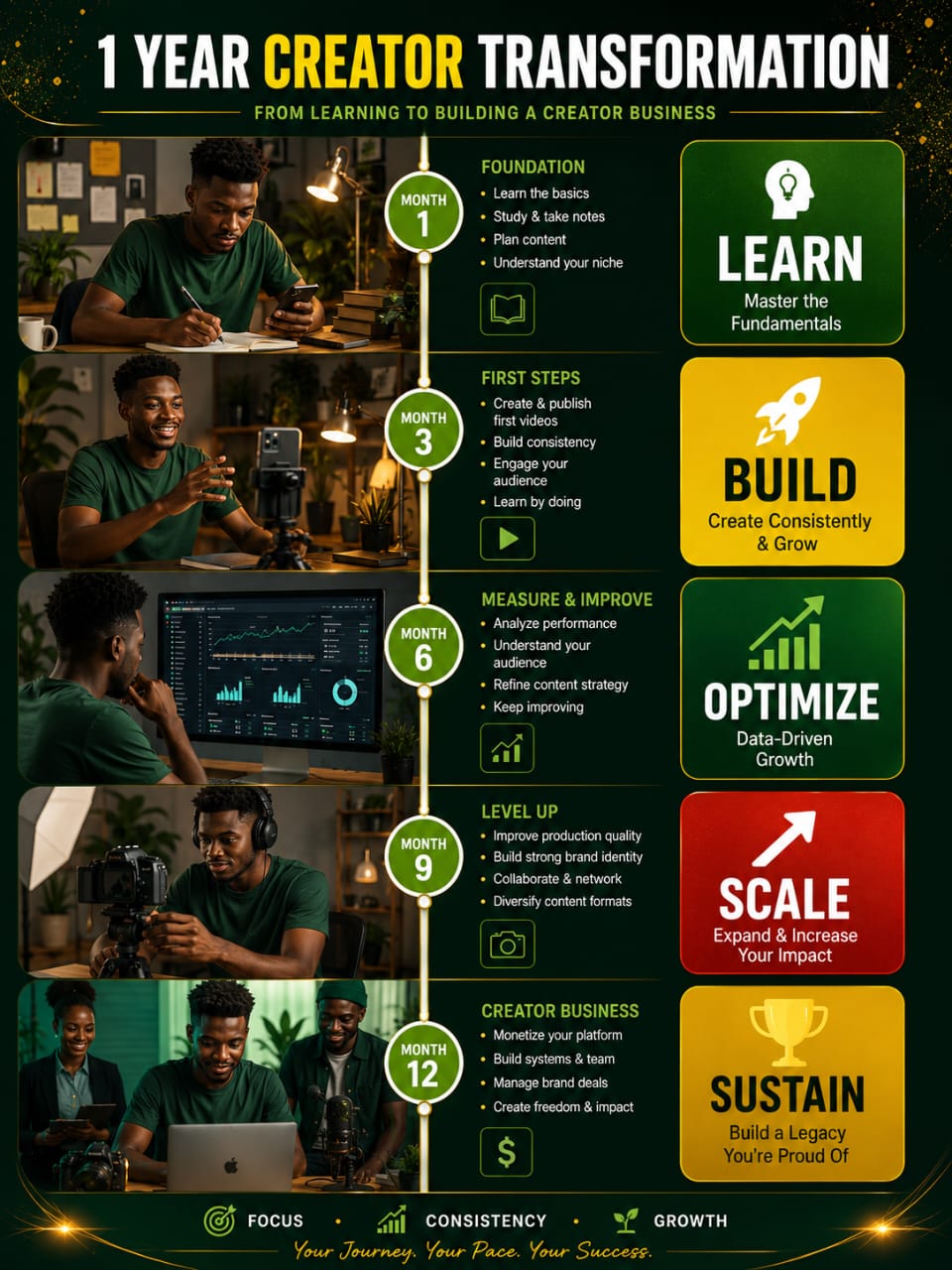
PURPOSE:
Visualizes the gradual progression from beginner to professional creator.
33. THINGS I DON'T WANT YOU TO DO AS A BEGINNER
1. Don't buy expensive equipment too early
Your first problem is usually not your camera.
It's your content.
2. Don't copy another creator
Study them.
Learn from them.
But develop your own voice.
3. Don't post completely random topics
Your channel should give viewers some idea of what to expect.
4. Don't chase every trend
A trend that has nothing to do with your audience may attract the wrong viewers.
5. Don't obsess over subscribers
Look at actual viewer behavior.
6. Don't buy subscribers or views
Artificial numbers do not build a healthy audience.
7. Don't use copyrighted material carelessly
“Everybody else is doing it
” is not a copyright defense.
8. Don't turn AI into a spam machine
Mass-produced repetitive content is not the same thing as a creative business.
9. Don't publish without understanding your audience
You don't need perfect audience research.
But you need a reason for making the video.
10. Don't quit after five videos
Five videos provide very little evidence about your long-term potential.
11. Don't make every video unnecessarily long
Respect people's time.
12. Don't ignore analytics
Your audience is giving you information.
Read it.
13. Don't change your niche every week
Give your direction enough time to produce useful evidence.
14. Don't wait for perfection
Your first video is allowed to be your first video.
34. WHAT IF NOBODY WATCHES?
Let's talk honestly.
You spend hours planning.
You record.
You edit.
You upload.
Then you check the video.
27 views.
You refresh.
31 views.
The next day:
42 views.
It can hurt.
Especially when you see someone else upload something and receive thousands.
But don't let the emotional reaction become your business strategy.
Your first job is not to prove that you are already successful.
Your first job is to learn how to become good.
If only 30 people watched, study those 30.
If nobody commented, ask whether your video created a reason to respond.
If the opening lost people, improve the opening.
If the topic wasn't interesting, choose a stronger problem.
If the packaging was unclear, improve the title and thumbnail.
And then make another video.
YouTube itself notes that one underperforming video does not automatically punish the entire channel; recommendations are heavily informed by how viewers respond to individual videos and audience-level signals.
Your first videos are not wasted.
They are your training ground.
35. YOUR WEEKLY YOUTUBE WORK
FLOW
You don't have to follow this exact schedule, but here is a practical model.
DAY 1 — RESEARCH
Find:
- Questions
- Problems
- Trends relevant to your niche
- Competitor gaps
- Search ideas
- Audience comments
DAY 2 — IDEA SELECTION
Choose one idea.
Write:
- Audience
- Problem
- Promise
- Main takeaway
DAY 3 — PACKAGING
Create:
- Title options
- Thumbnail concept
- Opening hook
Do this before filming when possible.
It forces you to understand what the video is actually about.
DAY 4 — SCRIPT
Create the structure.
You don't necessarily need to write every word.
For some formats, bullet points are enough.
DAY 5 — RECORD
Focus on:
- Audio
- Lighting
- Clear delivery
- Energy
- Accuracy
DAY 6 — EDIT
Remove:
- Repetition
- Long pauses
- Unnecessary sections
- Confusing explanations
Add visuals where they genuinely help.
DAY 7 — PUBLISH + ANALYZE
Publish.
Then later study the data.
Don't sit in YouTube Studio refreshing the view count every three minutes.
36. YOUR UPLOAD CHECKLIST
Before publishing, ask:
- Do I know who this video is for?
- Does the video solve a real problem or satisfy a real interest?
- Is the title accurate and clear?
- Does the thumbnail communicate one strong idea?
- Does the opening quickly establish value?
- Is the information accurate?
- Have I checked copyright issues?
- Is the content meaningfully original?
- Have I avoided misleading claims?
- Is the description useful where appropriate?
- Have I considered an end screen or other relevant channel-navigation tools?
- Would a playlist help the viewer continue learning?
- Have I checked the appropriate YouTube Studio settings?
- Am I ready to study the result rather than obsess over it?
37. THE BEGINNER-TO-PRO MINDSET
You don't become a professional simply because your subscriber number reaches a particular number.
Professionalism comes from developing better judgment.
A serious creator learns to improve:
Audience understanding
Who am I serving?
Ideas
What is worth making?
Storytelling
How do I hold attention?
Packaging
How do I communicate the value?
Production
How do I make the experience better?
Analytics
What is the audience telling me?
Business
How does this attention create legitimate value?
Consistency
Can I keep doing this?
Judgment
What should I stop doing?
That last one is underrated.
Growth is not only about learning what to add.
Sometimes it is learning what to remove.
38. THE COMPLETE BEGINNER-TO-PRO ROADMAP
Here is your entire journey in one picture:
STEP 1 — CHOOSE YOUR AUDIENCE
Who are you serving?
STEP 2 — CHOOSE YOUR CHANNEL PROMISE
What can they expect from you?
STEP 3 — FIND THEIR PROBLEMS
What do they need, want or care about?
STEP 4 — TURN PROBLEMS INTO IDEAS
Create useful video concepts.
STEP 5 — PACKAGE THE IDEA
Develop the title and thumbnail concept.
STEP 6 — BUILD THE VIDEO
Hook → explain → demonstrate → deliver value.
STEP 7 — PUBLISH
Don't wait for perfection.
STEP 8 — STUDY THE RESPONSE
Impressions → CTR → retention → traffic → satisfaction signals.
STEP 9 — LEARN
What worked?
What didn't?
STEP 10 — MAKE THE NEXT VIDEO BETTER
STEP 11 — BUILD TRUST
STEP 12 — BUILD OPPORTUNITIES
STEP 13 — BUILD INCOME
STEP 14 — BUILD THE BUSINESS
That is the journey.
39. YOUR FIRST 10 ACTIONS AFTER THIS LESSON
Don't close this article and simply say:
That was useful.
Do something.
1. Choose your audience.
Write down one specific group you want to serve.
2. Define your channel promise.
Complete:
“My channel helps __ to
3. Write 20 problems your audience has.
Don't overthink them.
Write real questions.
4. Turn 10 problems into video ideas.
One problem can become one video.
5. Choose your first video.
Pick something you can realistically deliver well.
6. Write three titles.
Don't settle for the first title that comes to mind.
7. Sketch the thumbnail.
Even on paper.
Ask:
“Can I understand the idea quickly?
8. Write your opening.
Give the viewer a reason to stay.
9. Record with what you have.
Your smartphone is enough to begin learning.
10. Publish and study.
Your first video is not your final product.
It is your first lesson.
40. FINAL CREATIVE BLOG ACADEMY LESSON
If you remember only one thing from this entire masterclass, remember this:
YouTube is not a lottery ticket.
You cannot control whether a particular video goes viral.
You cannot guarantee subscribers.
You cannot force people to watch.
You cannot command the recommendation system to choose your video.
But you can control something much more powerful:
Your ability to become better at creating something people genuinely want.
You can learn your audience.
You can research better ideas.
You can make clearer titles.
You can design stronger thumbnails.
You can improve your first 30 seconds.
You can study retention.
You can understand your traffic sources.
You can respect copyright.
You can follow YouTube's policies.
You can use AI responsibly.
You can improve your production.
You can build trust.
And eventually, you can turn that trust into a legitimate creative career or business.
If you're starting from Nigeria, don't think your location automatically limits the size of your audience.
Your Nigerian perspective can be part of your advantage.
You can teach a Nigerian audience.
You can teach an African audience.
You can create content for a global audience.
You can even begin with nothing more than a smartphone, a clear idea and the willingness to learn.
But don't rush to become “big.
” First become useful.
Then become better.
Then become consistent.
Then become trusted.
Then learn how to turn what you've built into a sustainable business.
That's a much stronger foundation than chasing one viral video.
CREATIVE BLOG ACADEMY FINAL ASSIGNMENT
Before you start your channel, complete this:
My audience:
Their biggest problems:
1. ---
2. ---
3. ---
4. ---
5. ---
My channel promise:
My first 10 video ideas:
1. ---
2. ---
3. ---
4. ---
5. ---
6. ---
7. ---
8. ---
9. ---
10. ---
My first video:
My first title idea:
My thumbnail concept:
My publishing schedule:
Now you are no longer just saying:
“I want to start YouTube.
” You have a starting plan.
CALL TO ACTION
Your YouTube journey does not begin when you buy an expensive camera.
It begins when you decide to learn, create and publish.
If this masterclass helped you understand YouTube more clearly, keep learning with Creative Blog Academy, where practical knowledge is turned into skills you can actually use.
Explore more lessons from Creative Blog Africa, practice what you have learned, share this masterclass with another beginner who is trying to find their way on YouTube, and keep building.
Learn the skill.
Create the value.
Build the audience.
Build the opportunity.
Creative Blog Academy
Learn. Create. Grow.
SEO PACKAGE
SEO TITLE
YouTube Blueprint 2026: Complete Beginner’s Roadmap to Growth & Monetization
META DESCRIPTION
Learn how to start YouTube in 2026, grow an audience, understand the algorithm, create better videos, use analytics and work toward monetization.
FOCUS KEYWORD
YouTube beginner guide 2026
SECONDARY KEYWORDS
- How to start YouTube in 2026
- YouTube roadmap for beginners
- YouTube algorithm 2026
- How to grow a YouTube channel
- YouTube monetization 2026
- YouTube Partner Program requirements
- YouTube Shorts vs long-form
- YouTube analytics for beginners
- How to get YouTube views
- YouTube content strategy
SLUG
youtube-blueprint-2026-beginners
SEARCH INTENT
Informational and educational intent: the reader wants a complete beginner-friendly roadmap for starting, growing and monetizing a YouTube channel in 2026.
ARTICLE EXCERPT
Starting YouTube in 2026 doesn't require an expensive camera or thousands of subscribers. This complete beginner's roadmap explains how YouTube works, how to create better videos, understand analytics, follow the rules and build toward a sustainable creator career.
FACEBOOK / X PROMOTION
You want to start YouTube in 2026 but don't know where to begin?
We built a complete beginner's roadmap covering everything from choosing your niche and finding video ideas to thumbnails, retention, analytics, Shorts, copyright, AI, YPP monetization and turning your channel into a real business.
No hype. No “go viral overnight” promises.
Just practical YouTube education from Creative Blog Academy.
Read the full masterclass and start building with a plan.
Creative Blog Academy — Learn. Create. Grow.
YOUTUBE PROMOTION DESCRIPTION
Thinking about starting YouTube in 2026?
This Creative Blog Academy masterclass takes you from the basics to a practical creator roadmap. Learn how YouTube recommendations work, how to choose a niche, find video ideas, create stronger titles and thumbnails, improve retention, understand YouTube Analytics, use Shorts strategically, avoid copyright and reused-content problems, use AI responsibly, understand YPP monetization and build YouTube into a sustainable career or business.
Whether you're starting with a smartphone in Nigeria, elsewhere in Africa or anywhere in the world, this guide gives you a practical foundation.
Read the full lesson and start building your channel strategically.
INSTAGRAM CAPTION
Thinking about starting YouTube in 2026? Don't start by asking:
“How do I go viral?
” Start by asking:
“Who am I creating for, and what value can I give them?
” Our new Creative Blog Academy masterclass breaks YouTube down from the ground up:
* Choosing your niche
* Finding video ideas
* Understanding recommendations
* Titles & thumbnails
* The first 30 seconds
* Retention
* Shorts vs long-form
* YouTube Analytics
* Copyright
* Reused content
* Responsible AI use
* YPP monetization
* Sponsorships
* Your first 90 days
* Your first 12 months
* Turning YouTube into a business
No expensive equipment required.
No guaranteed-viral nonsense.
Just a practical roadmap for building real skills.
Read the full masterclass on Creative Blog Africa.
#CJCreativeAcademy #YouTubeForBeginners #YouTube2026 #YouTubeTips #ContentCreation #YouTubeNigeria
Join CJ Creative Academy
Build valuable digital skills.
Courses are free, and Membership is #25,000 to get full access.
Ready to start learning? click Join Our Academy
     |    |   |