How to Start Writing Professionally in 2026
Content writing is no longer just about knowing how to write. In 2026, it is about knowing how to think, research, communicate, understand people and create content that actually provides value.
If you have ever looked at a blog post, social media caption or website article and thought, “I can do this too,” you may already have the first thing you need to begin your journey as a content writer: the willingness to learn.
At Creative Blog Africa, we believe digital skills should not feel complicated or inaccessible.
That is why, through Creative Blog Academy, we are taking beginners through the fundamentals of content writing and showing them how writing can become a practical digital skill.
In this first lesson, we go back to the beginning:
What exactly is content writing, how does it work, and how can a beginner start?
Watch the Full Lesson
Before we get into the details, you can watch the full video lesson below.

What Is Content Writing?
At its simplest, content writing is the process of creating written material for a specific audience and purpose.
That content can educate, inform, entertain, answer questions, solve problems or help an audience understand a particular subject.
Think about the information you consume every day.
You might read:
A blog article explaining how to start a business
An Instagram caption teaching a new skill
A website explaining a company's services
An article answering a question you searched on Google
A product description before buying something online
An e-book teaching you something new
Behind much of this content is a writer.
And that is where content writing becomes interesting.
You are not simply putting words together.
You are using words to communicate something valuable to another person.

Why Content Writing Matters in 2026
The internet has changed the way businesses communicate.
A business can no longer depend entirely on a physical location or traditional advertising.
Businesses, creators, organizations and personal brands now need a digital presence.
And a digital presence needs content.
A business may need someone to write its:
Website pages
Blog articles
Social media captions
Email content
Product descriptions
Educational resources
SEO articles
Scripts and other digital materials
This creates opportunities for writers who understand how to communicate effectively online.
But there is another reality beginners need to understand.
Content Writing Has Entered the AI Era
Artificial intelligence can now generate text in seconds.
So does that mean human content writers are no longer needed?
Not at all.
In fact, the role of a good writer is becoming more valuable in a different way.
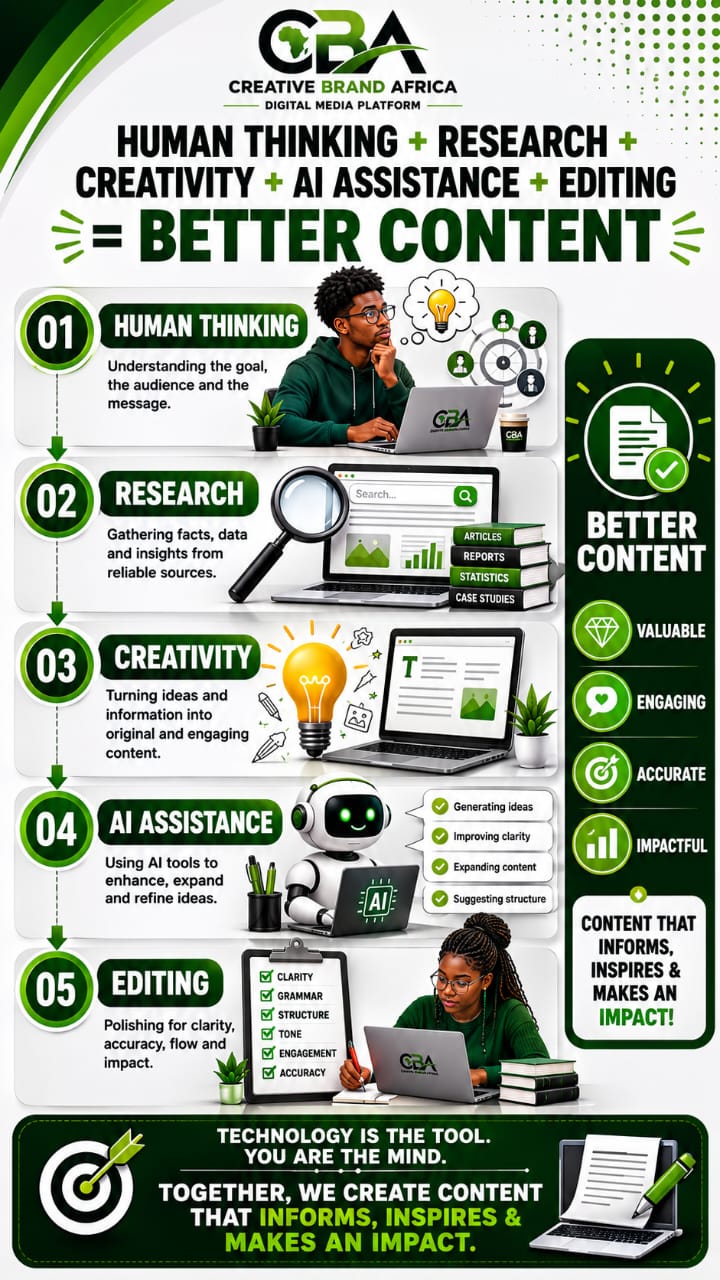
AI can help generate words, but professional content still requires:
Research.
Strategy.
Human understanding.
Accuracy.
Original thinking.
Creativity.
Brand understanding.
Editorial judgment.
A modern content writer should therefore learn how to work with AI without allowing AI to replace their thinking.
The goal isn't to compete with technology.
The goal is to know how to use technology intelligently while maintaining human quality.
THE MODERN CONTENT WRITER
Content Writing vs Copywriting: Are They the Same?
This is one of the first things every beginner should understand.
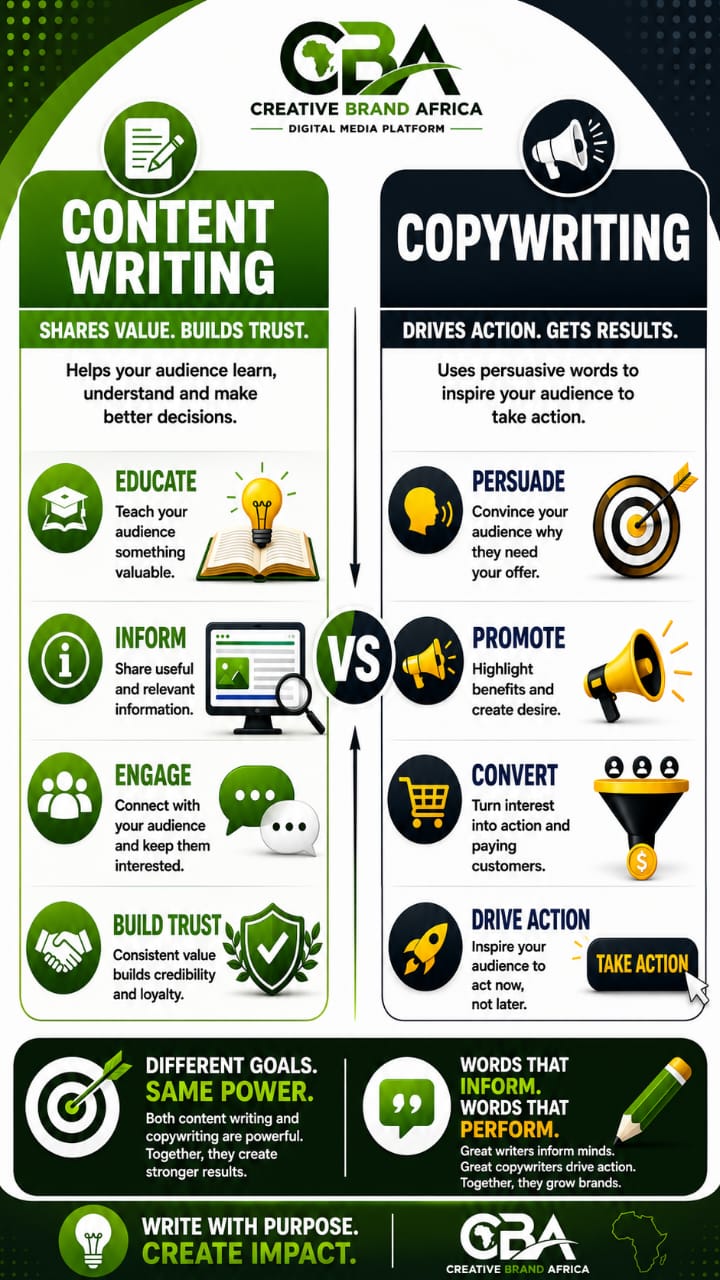
Content writing and copywriting are connected, but their primary purposes are different.
Content Writing
Content writing generally focuses on:
Educating → Informing → Helping → Engaging → Building Trust
For example:
7 Things Every Beginner Should Know Before Starting Freelancing.
The reader is primarily receiving useful information.
Copywriting
Copywriting focuses more heavily on:
Persuading → Convincing → Driving Action
For example:
Ready to Start Freelancing? Join Our Beginner Training Today.
The objective is to encourage the reader to take action.
The easiest way to remember it
Content writing says:
Let me give you something useful.
Copywriting says:
Let me convince you to do something.
As you progress as a writer, learning both skills can make you much more versatile.
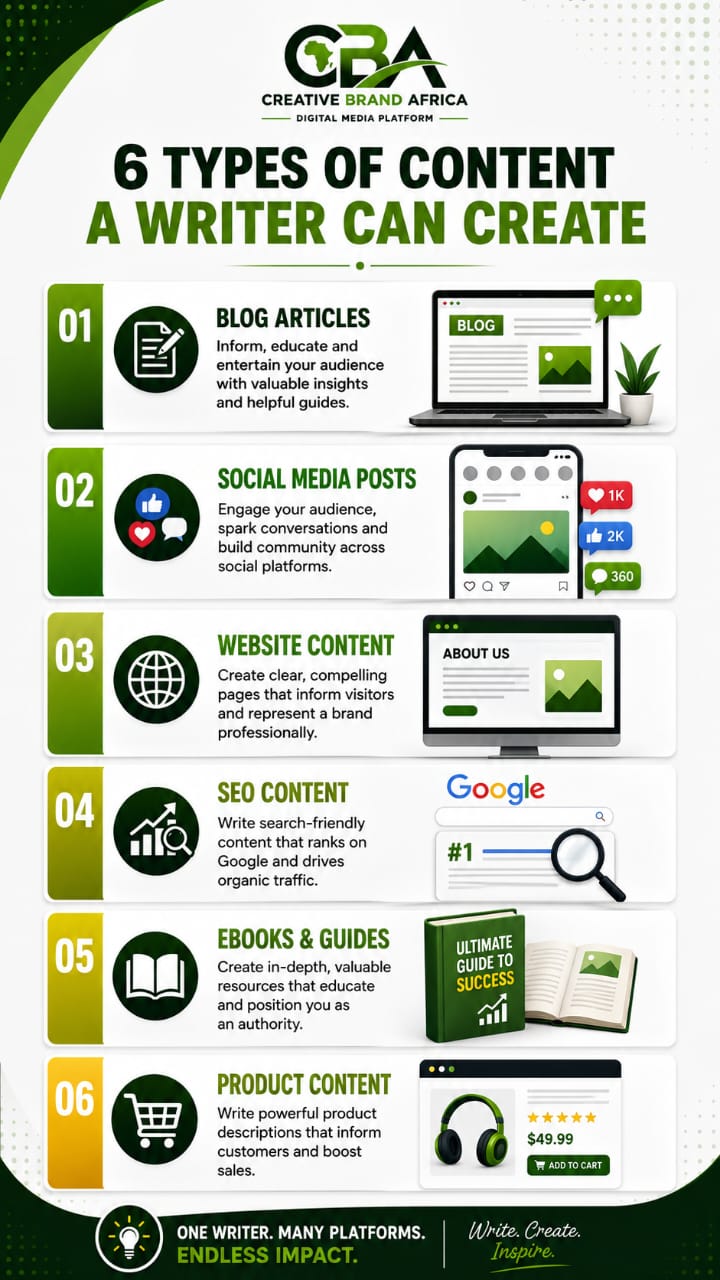
What Types of Content Can a Writer Create?
One exciting thing about content writing is that you are not restricted to one format.
A writer may specialize in one area or eventually learn several.
1. Blog Articles
These are informational or entertaining articles published on websites and blogs.
Examples include:
How to guides
Tutorials
Educational articles
Industry articles
Listicles
Opinion pieces
2.Social Media Content
Brands need writers who can turn ideas into engaging captions and social content.
3. Website Content
This includes pages such as:
About Us
Services
Contact
FAQs
Landing pages
4.SEO Content
SEO content is created with search visibility in mind while still providing genuine value to readers.
5. Ebooks and Guides
Long-form educational materials can also be created by content writers.
6. Product Content
E-commerce businesses need clear and persuasive descriptions that help customers understand what they are buying
6 TYPES OF CONTENT A WRITER CAN CREATE
Before You Write, Know Your Reader
Here is one lesson I want every beginner to remember:
Don't start writing simply because you have a topic. Start writing because you understand the person who needs the information.
Imagine you want to write about laptops.
Are you writing for:
- A university student?
- A graphic designer?
- A business owner?
-A gamer?
- A programmer?
- Someone buying their first computer?
Each person has different needs.
A professional writer therefore asks:
Who am I writing for?
What does this person need?
What problem are they trying to solve?
What information will help them?
What tone will they understand?
This is where empathy becomes an important writing skill.
Write to People, Not at People
Compare these two introductions:
Version A:
Content writers should understand the importance of identifying their target audience before creating content.
Version B:
If you're new to content writing, one of the first questions you should ask yourself is simple: Who am I writing for?
Which one feels more personal?
The second one.
Why?
Because it feels like someone is actually talking to you.
Great content creates that feeling.
Don't write at your audience.
Write to your audience.

What Makes Content Good?
Good content isn't simply content with perfect grammar.
Grammar matters, but professional writing goes much further.
Great content should be:
Useful
The reader should gain something from it.
Clear
Don't use complicated language when a simple explanation will work.
Relevant
The information should match what the audience actually needs.
Original
Your content should not simply reproduce somebody else's work.
Engaging
Give people a reason to continue reading.
Well-structured
Use headings, short paragraphs, lists and examples to make the information easy to consume.
Accurate
Research your information and avoid spreading misinformation.
Research: The Skill Behind Good Writing
One of the biggest mistakes beginners make is believing that a writer should simply sit down and start typing.
Professional writing usually begins before the first sentence is written.
It begins with research.
If you are writing about a subject you don't fully understand, investigate it.
Look for: Reliable sources
- Relevant statistics
- Expert information
- Official sources
- Current developments
- Questions people are asking
- Different perspectives
Then use what you learn to create something useful and original.
Remember:
Research is not copying.
You research to understand.
You then use your own structure, explanation, examples and voice to communicate the information.
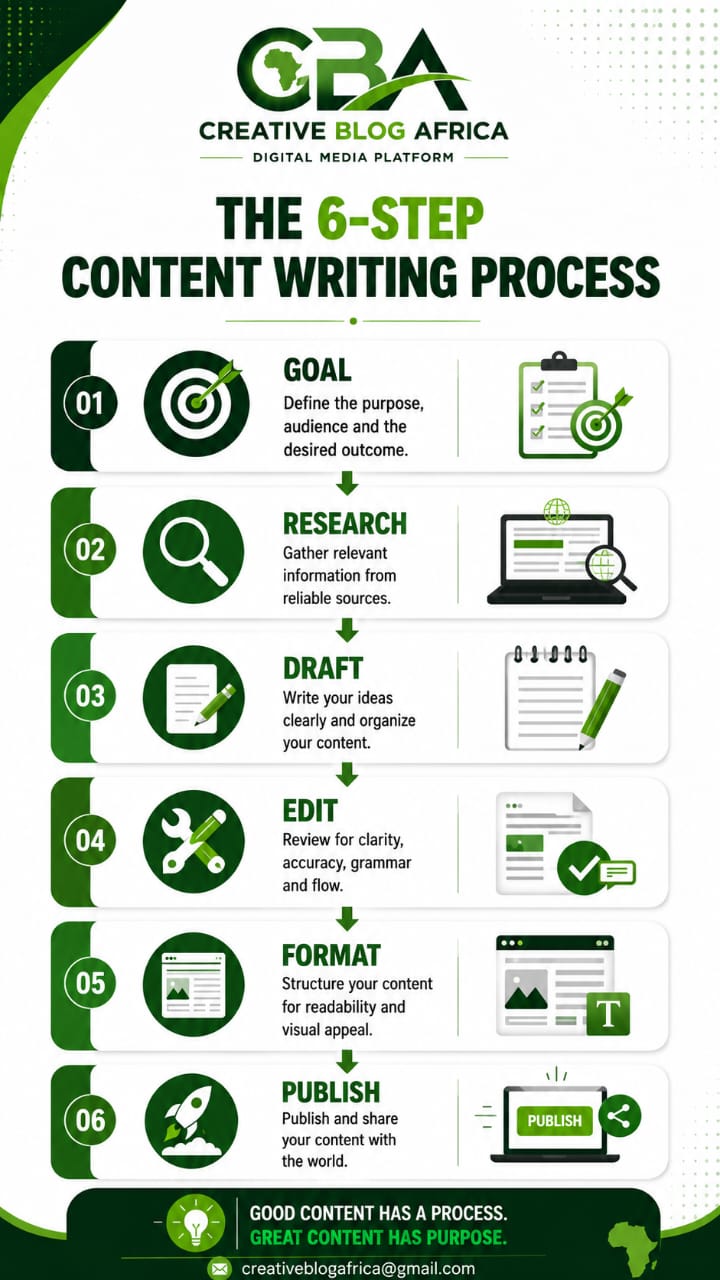
The Six-Step Content Writing Process
Once you understand your audience and topic, you can begin the actual writing process.
At Creative Blog Academy, beginners can remember the process through six simple stages:
1. DEFINE THE GOAL Ask:
Why am I creating this content?
Is the purpose to educate, inform, entertain, answer a question or build awareness?
2. RESEARCH Learn about the subject.
Understand what your audience wants to know and gather reliable information.
3. DRAFT Write your first version.
Don't spend ten minutes trying to make one sentence perfect.
Get your ideas down first.
4. EDIT Now improve your work.
Check:
- Grammar
- Spelling
- Clarity
- Accuracy
- Repetition
- Structure
5. FORMAT Make the content easy to read.
Use:
- Headings
- Subheadings
- Short paragraphs
- Bullet points
- Lists
- Relevant visuals
6. PUBLISH
Prepare the final content for its intended platform and publish or submit it.
Your formula:
GOAL → RESEARCH → DRAFT → EDIT → FORMAT → PUBLISH
Why Your Headline Matters
Before someone reads your article, they see your headline.
Compare:
Content Writing Tips
with:
10 Content Writing Mistakes Beginners Should Avoid in 2026»
The second one immediately tells the reader more.
A strong headline should be:
- Clear
- Specific
- Relevant
- Interesting
- Honest
But don't confuse an interesting headline with clickbait.
Your headline should make a promise that your article actually delivers.
Make Your Content Easy to Read
Most people don't approach online content the same way they approach a printed book.
They may be using a phone.
They may be distracted.
They may be quickly searching for one answer.
That means your formatting matters.
Instead of writing one massive paragraph, break your information into smaller sections.
Use:
Clear headings
Short explanations.
Bullet points
Important information.
Examples
Practical explanations.
Visuals
Images and infographics where they genuinely improve understanding.
Good formatting doesn't make your content less professional.
It makes it easier to understand.
Your Writing Should Have a Voice
Imagine reading content from five different brands.
A bank should not necessarily sound like a comedy page.
A children's education brand should not necessarily sound like a law firm.
A fashion brand may use a completely different tone from a technology company.
That is why professional writers need to understand brand voice.
You should be able to adapt your writing to the:
Brand + Audience + Platform + Purpose
Useful Tools for Beginner Writers
You don't need dozens of expensive tools to begin.
A few useful tools can support your workflow.
Grammarly
Useful for grammar, spelling and writing suggestions.
Google Docs
Useful for writing, editing, collaboration and storing documents.
AnswerThePublic
Useful for discovering questions and topics people are interested in.
AI Writing Tools
AI can help with brainstorming, outlining, editing and generating ideas.
But don't make the mistake of publishing AI-generated content without reviewing it.
Your name is attached to the final work—not the AI's name.
The Biggest Mistakes Beginners Should Avoid
If you're just starting, watch out for these mistakes:
Writing without identifying the audience
Copying other people's work
Writing without research
Using unnecessarily complicated language
Creating huge blocks of text
Publishing without editing
Ignoring the brand's tone
Depending completely on AI
Writing without a clear purpose
Giving up because the first article isn't perfect
Every professional writer started somewhere.
The difference is that professionals kept practicing.
Can You Really Start Content Writing as a Beginner?
Yes.
You don't need to know everything before you begin.
You need to start learning the fundamentals, practice consistently and gradually build your ability.
Start small.
Write an article.
Edit it.
Ask someone to review it.
Rewrite it.
Write another one.
Then another.
Over time, you'll begin to recognize your own weaknesses and strengths.
That is how writing improves.
Your First Content-Writing Challenge
Now that you've learned the fundamentals, here's a simple challenge.
Write an article on:
How Creative Blog Academy Has Help Me GAIN Digital Skills in 2026.
Before you write, identify:
Audience:
Beginners interested in digital skills.
Problem:
They don't know where or how to start.
Goal:
Educate and guide them.
Your article should contain:
- A clear headline
- An engaging introduction
- At least three subheadings
- Useful information
- Practical examples
- Short paragraphs
- A conclusion
Then edit your work before considering it finished.
The Most Important Lesson
If you remember only one thing from this article, remember this:
Content writing is not about filling a page with words.
It is about using words to create value for a specific person.
When you understand your reader, research your subject, communicate clearly and continuously improve your writing, you begin to move from simply writing to actually creating content professionally.
And in 2026, that distinction matters more than ever.
Continue Learning With Creative Blog Academy
This article is only the beginning.
At Creative Blog Academy, our goal is to help beginners understand the practical side of digital content creation—not just memorize definitions.
We want you to learn how to:
Think → Research → Write → Edit → Create → Improve
Whether your goal is to become a freelance writer, contribute to blogs, work with brands, manage social media content or build your own digital platform, the fundamentals you learn here can become the foundation for your journey.
If you came into this lesson knowing very little about content writing, hopefully you are leaving with something more valuable:
a clearer understanding of where to start.
And that's exactly where every professional writer once began.

Final Thought
Your first article may not be perfect.
Your second may still have mistakes.
That's completely normal.
The goal isn't to become perfect overnight.
The goal is to become better with every piece of content you create.
Write. Learn. Improve. Repeat.
Welcome to the world of content writing.
Creative Blog Academy
Learn. Create. Influence the Digital World.
And Let me Know what you will like to learn next on the comment section below

Wow thanks so much I learnt a lot from this free class 🤗🙈I can’t believe this is free
More educative than some paid training
Wow this is nice thanks so much, it is much engaging and informative
Wow!!
I thought I knew about content writing but this class just opened me up to a great level of understanding. It was educative and impactful.Thank you Creative Blog Academy 🙏🏾
You are welcome
Comments like this encourage us to create more educational content
You’re welcome, and thanks for the feedback
Expect more from us
The class is nice, it is engaging and informative thanks
Wow I thought I knew about content writing but this class just opened my understanding to much more. This is very impactful 🙏🏾
This is quite insightful and very simple to understand. Thank you for breaking it into simple steps.
I understand that content writing is not just about writing, but about writing intentionally with a target audience in mind and the empathy that is necessary to achieve a goal.